Your Weekend Workout Is the Riskiest Thing You Do
by: Chin Yi Khern, Physiotherapist, Regis Wellness
Last updated: March 16, 2026
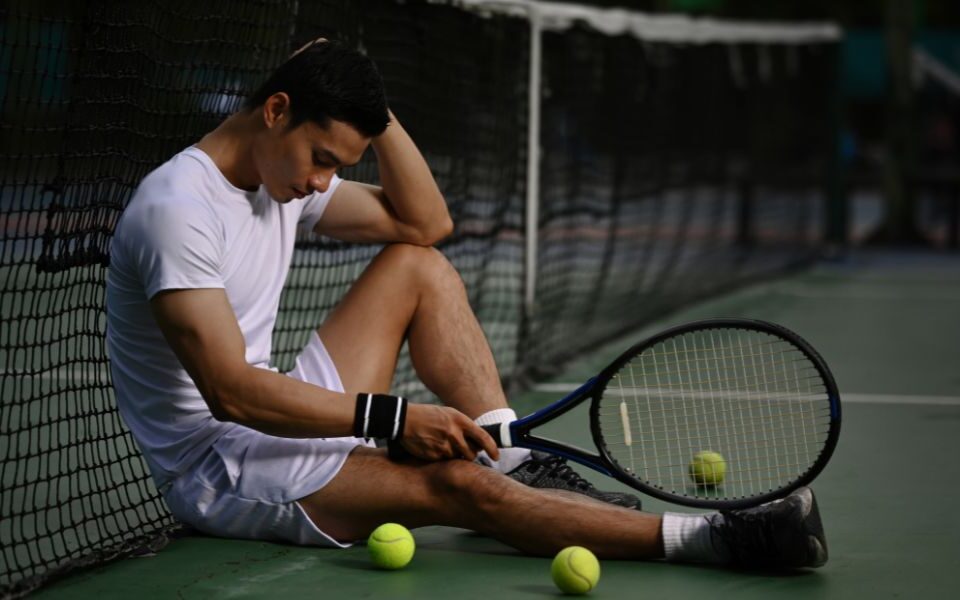
You play badminton twice a week. Maybe you run on Sunday mornings. You've been doing it for years without any issues. Then one week your achilles starts aching. Or your knee hurts going downstairs. Or your elbow flares up mid game. You didn't do anything different. You didn't fall or twist anything. So why now? The answer is probably weeks in the making, and it has less to do with your sport than you think.
Most people assume overuse injuries come from doing too much. The name says it right there. Overuse. Too much tennis. Too many kilometers. Too many games of pickleball.
But that's not what the research shows. And once you understand what actually causes these injuries, the way you think about your training, your weekends, and your body's limits changes entirely.
Manage Overuse Injuries with Regis Wellness
High quality, effective, holistic treatment
The Term "Overuse" Is Misleading
Sports medicine researchers have been pushing to retire the term "overuse injury" for years. Drew and Purdam argued in the British Journal of Sports Medicine that a more accurate name would be "training load error." The injury doesn't happen because you used your body too much in an absolute sense. It happens because you asked your body to do significantly more than it was prepared for, more quickly than it could adapt.
That's a critical distinction. It means the root cause isn't the amount of activity. It's the mismatch between the demand you placed on your body and the resilience your body had built up to handle it.
Think about it this way. A marathon runner covering 60 kilometres a week rarely gets injured from a 10k Sunday run. That distance is well within what their body is conditioned for. But a desk worker who runs the same 10k on Saturday morning after doing almost nothing all week? That identical distance represents a massive spike in load relative to what their tissues are used to. Same activity, completely different risk profile.
The Paradox: Training More Actually Protects You
This is the finding that flips everything most people believe.
In 2016, sports scientist Tim Gabbett published a landmark paper in the British Journal of Sports Medicine titled "The Training Injury Prevention Paradox." His research across elite rugby, cricket, and football showed that athletes with higher chronic training loads, built gradually over time, actually had lower injury rates.
Read that again. The athletes who trained harder got injured less.
The ones who got hurt the most weren't the hardest workers. They were the athletes with the biggest spikes: sudden jumps in training load that their bodies weren't prepared for. Gabbett found that when an athlete's acute workload (roughly the past week) exceeded 1.5 times their chronic workload (their four week rolling average), injury risk spiked sharply. The sweet spot for staying healthy was an acute to chronic workload ratio between 0.8 and 1.3.
So what does this mean for you? If you've been sitting at a desk all week and your chronic training load is close to zero, even a moderate weekend session represents a ratio well above 1.5. Possibly above 3.0. You're operating deep in the danger zone every Saturday morning and you probably don't even realise it.
The paradox is real: training more during the week, even in small amounts, would actually make your weekend sport safer.
Why Singapore's Fitness Culture Creates the Perfect Storm
This isn't just a theoretical problem. Singapore's lifestyle practically engineers this injury pattern.
Most Singaporeans work long hours. Then the commute, to work and back home. You sit for eight or nine hours a day in air conditioning, which does your muscles and joints no favours either. During the week, your body's physical load is almost zero outside of walking to the MRT.
Then the weekend arrives and you're thinking: "I finally have some time to exercise." You're on the badminton court for two hours. Or you lace up for a 10k around East Coast Park. Or you play three sets of tennis in 32 degree heat. Your heart rate spikes, your muscles fire, your joints absorb impact, your tendons stretch under load. For those two hours, your body is being asked to perform like an athlete's. For the other 110 waking hours that week, it was asked to do almost nothing.
That gap is the injury mechanism.
Add in a few factors specific to Singapore and the risk compounds. The pickleball boom has brought thousands of people into a high repetition overhead sport with almost no conditioning runway. The heat and humidity affect recovery, hydration, and tissue elasticity. There's a culture of maximising the session because you booked the court and you're paying for it. And the 30 to 50 demographic, which makes up most of Singapore's recreational sport scene, is exactly the age range where tissue resilience starts declining but intensity expectations don't adjust to match.
Sports injury epidemiology data shows that weekend warriors aged 35 to 50 have approximately 50% higher acute injury rates compared to people who exercise consistently throughout the week. That number isn't surprising when you understand the loading mismatch. It's the natural consequence.
Your Tendons Are the Weak Link (and They Won't Tell You Until It's Too Late)
Here's why overuse injuries feel like they come out of nowhere.
Your muscles adapt to new training loads within days to weeks. If you start running after a break, your legs will feel sore for a few days, then adjust. Within a week or two, the same distance feels manageable. Your muscles have adapted. They're keeping up.
Your tendons have not.
Tendons, the dense connective tissue that anchors muscle to bone, adapt on a much slower timeline. Research suggests they need two to three months of consistent progressive loading to meaningfully remodel and strengthen. During those months, while your muscles feel fine and your cardiovascular fitness is improving, your tendons are quietly accumulating microtrauma from each session. The repair rate is slower than the damage rate. But you don't feel it because tendons have poor nerve supply and don't signal pain until the damage is significant.
This is exactly why achilles tendinopathy, plantar fasciitis, tennis elbow, and runner's knee all follow the same story. No single incident. No dramatic moment. Just a gradual onset of pain that seems to appear from nowhere. But it didn't come from nowhere. It was building for weeks while everything felt fine.
The "I Was Fine Until I Wasn't" Problem
This pattern is so common in our clinic that it's almost a script.
You’ve played social badminton for five years. Same group, same court, same time every week. Never had a problem. Then one Saturday your shoulder starts aching during overhead clears. Within two weeks it hurts to lift your arm above your head. You can't figure out what changed.
What changed is nothing. And that's the problem. Your body has been absorbing the same repetitive load without progressive conditioning for years. Your rotator cuff tendons have been slowly accumulating strain without any strengthening work to build their capacity. Your desk job has been gradually stiffening your thoracic spine, forcing your shoulder to compensate with more range than it should. The injury didn't happen on Saturday. Saturday is just when the bill finally came due.
This is the hallmark of a loading error disguised as overuse. The tissue's tolerance was exceeded incrementally, not suddenly. And because there's no dramatic injury event, no twist, no fall, no pop, people tend to dismiss the early warning signs, push through, and only seek help when the problem is entrenched and takes much longer to resolve.
The Early Warning Signs Most People Ignore
Overuse injuries almost always give you signals before they become a real problem. The issue is that those signals are easy to dismiss.
Pain that appears at the start of activity but warms up and fades after ten minutes is usually the first sign. Most people interpret this as "it's fine once I get going." In reality, it means the tissue is irritated but the increased blood flow from exercise temporarily masks the problem. The underlying damage is still accumulating.
Stiffness the morning after a session that takes longer to ease than it used to. A vague ache in a joint or tendon that wasn't there six months ago. Soreness that shifts from one side to the other as your body compensates. Decreased performance, needing more effort to achieve the same output, without any obvious reason.
These are all loading signals. They're your body's way of saying the demand is approaching the limit of what the tissue can handle. Paying attention at this stage and adjusting, whether that means modifying load, adding midweek conditioning, or getting a physio assessment, is the difference between a two week correction and a three month rehabilitation.
What Actually Prevents Overuse Injuries
If the problem is a mismatch between demand and preparation, the solution is narrowing that gap. Not by doing less on weekends, but by doing more during the week.
Build chronic load gradually. Even two or three short sessions during the week, 20 to 30 minutes of conditioning, strength work, or a light jog, dramatically changes your acute to chronic workload ratio. Your weekend session goes from being a massive spike to a manageable peak. Your tissues stay conditioned instead of being shocked every Saturday.
Respect tendon timelines. If you're starting a new sport or increasing your training volume, give it eight to twelve weeks of gradual progression before you settle into your target intensity. Your muscles will feel ready long before your tendons are. Patience during this window prevents most recreational overuse injuries.
Vary your movement. Repetitive strain means exactly that: strain from repetition. If you play the same sport every weekend with the same movement patterns, the same structures absorb load every time. Cross training, even casually, distributes load across different tissues and gives overworked structures a chance to recover.
Don't ignore the weekday body. If you sit for eight hours a day, your hips, thoracic spine, and glutes are deconditioned regardless of what you do on weekends. We covered this in our article on why your lower back hurts after sitting all day. That weekday deconditioning directly feeds weekend injury risk. Addressing it isn't optional if you want to stay active long term.
Get assessed before you're in pain. This is the one most people skip. A physio assessment can identify movement restrictions, strength deficits, and compensation patterns before they cause injury. For recreational athletes over 30 who are active on weekends, a periodic check up is one of the smartest investments you can make. It's significantly cheaper and less disruptive than treating an established tendinopathy or stress reaction.
Recovery management
- Guides appropriate training volume and rest intervals
- Helps prevent recurrence of overuse injuries
When to Stop Managing It Yourself
There's a point where stretching, foam rolling, and hoping it goes away stops being a strategy and starts being denial.
If pain has been present for more than two to three weeks and isn't improving, something structural is happening that self management won't resolve. If the same area keeps flaring up every time you play, you're in a cycle that needs breaking from outside. If pain is affecting your performance, your movement, or your willingness to play at all, you've already waited longer than you should have.
A sports physiotherapist can diagnose the specific tissue involved, identify the loading error that caused it, and build a rehabilitation plan that gets you back to your sport without the same problem recurring. Techniques like joint mobilisation restore movement in stiff joints that have been forcing other structures to compensate. Myofascial release addresses the tension patterns that develop when your body guards an injured area. And progressive loading protocols rebuild the tissue's capacity systematically so the same spike doesn't break the same structure again.
The earlier you get it looked at, the faster and simpler the fix. That's true for almost every overuse injury we see. The ones that take months to resolve are almost always the ones people sat on for months before coming in.
The Bottom Line
Most overuse injuries we see at our clinic share the same story. A recreational athlete who's been active for years, doing the same thing on weekends, and one day the pain just showed up. No incident, no trauma, no explanation. But there's always an explanation. It's usually a loading pattern that looked fine on the surface but was quietly accumulating tissue damage underneath. If that sounds familiar, come in and let's figure out what's driving it. Reach out on WhatsApp whenever you're ready.
Manage Overuse Injuries with Regis Wellness
Disclaimer:
The information on this website, including but not limited to, text, graphics, images, videos and all other materials contained on this website is for informational purposes only. None of the material is meant to replace a certified and registered Doctor's professional medical advice, diagnosis, and treatment.
No warranties or representations are given in respect of the medical information. Regis Wellness, Regis Wellness’s staff, and the website's operator will not be held liable if a user suffers any injury or loss after relying upon the medical information on this website.
Any devices used for technology-enhanced therapies are intended for use only for general well-being purposes or to encourage or maintain a healthy lifestyle and is not intended to be used for any medical purpose (such as the detection. diagnosis, monitoring, management or treatment of any medical condition or disease). Any health-related information provided by this device or software should not be treated as medical advice. Please consult a certified and registered Doctor for any medical advice required. As with all medical conditions, there are exceptions and nuances to individuals’ condition and treatment modalities. We aim to provide only a general understanding for each section.