Rock Climbing Injuries: Causes, Prevention and Recovery
by: Regis Wellness
Last updated: August 28, 2026
Fingers account for up to 52% of all climbing injuries. Shoulders make up another 17%. Elbows fill most of the rest. That means over 80% of climbing injuries occur in three areas, all driven by the same fundamental demand: pulling your bodyweight upward using structures that weren't designed for the magnitude or repetition of force climbing requires. Every one of these injuries is predictable. And most are preventable once you understand what's being loaded and why.
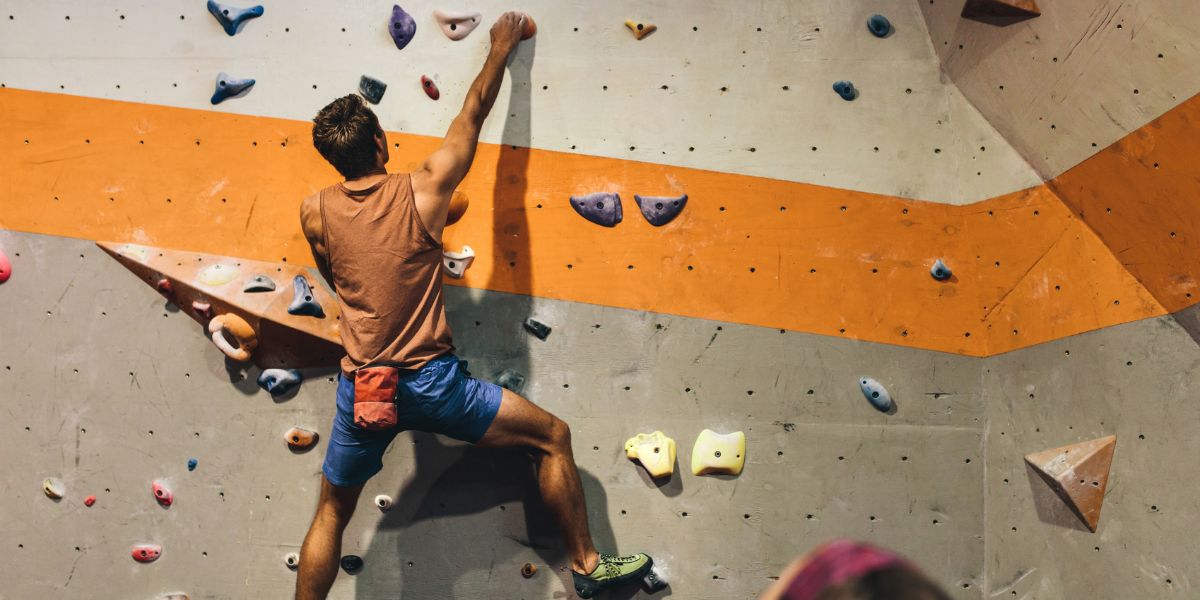
Climbing is growing fast in Singapore. Indoor bouldering gyms have multiplied across the island. The community is enthusiastic, welcoming, and addictive. And the injury rate among recreational climbers is climbing right alongside participation. Not because the sport is inherently dangerous, but because most people start climbing without understanding the specific demands it places on their body, and without any preparation for those demands.
This article breaks down the 60/40 split: 60% of climbing injuries affect the hand and wrist, 40% affect the shoulder and elbow. Each site has a distinct mechanism, a distinct set of risk factors, and a distinct approach to prevention and recovery.
Assess Your Pain at Regis Wellness
High quality, effective, holistic treatment
The 60%: Your Hands and Fingers
No other recreational sport asks your fingers to do what climbing does. In daily life, your fingers grip a coffee cup, a steering wheel, a phone. The forces involved are trivial. In climbing, your fingers support your entire bodyweight on holds that can be as small as a fingertip edge. The loading is extraordinary by any standard, and the structures absorbing it were never designed for this purpose.
The Pulley System: What It Is and Why It Breaks
To understand climbing finger injuries, you need to understand pulleys.
Your finger flexor tendons, the ropey structures that curl your fingers, run along the underside of each finger from the forearm to the fingertip. They're held close to the bone by a series of small fibrous bands called annular pulleys. There are five in each finger (A1 through A5). The A2 and A4 pulleys, which attach directly to bone at the proximal and middle phalanges respectively, are the most important for grip strength because they prevent the flexor tendons from "bowstringing" away from the bone when the finger is loaded.
When you grip a hold, the flexor tendons contract and pull. The pulleys hold the tendons against the bone so the force translates into finger flexion rather than the tendon lifting away from the skeleton. The system works beautifully under normal loading.
Climbing is not normal loading.
Research shows that the A2 pulley can withstand approximately 400 Newtons of force. A full crimp grip, where the fingers are curled with the proximal interphalangeal joint hyperflexed and the thumb locked over the index finger, generates up to 450 Newtons at the A2 pulley. You're routinely exceeding the structure's mechanical limit every time you crimp a small hold. The A2 pulley is the most frequently injured structure in climbing for exactly this reason.
A pulley injury can range from a mild strain (microtearing with local inflammation) to a partial or complete rupture. The classic presentation: you're crimping a hold, you hear or feel a pop at the base of the finger, and pain and swelling develop rapidly. In partial tears, you can still climb with discomfort. In complete ruptures, you'll notice visible bowstringing of the tendon and significant loss of grip strength.
The ring and middle fingers are the most commonly affected because they bear the greatest load during most grip positions. And the injury almost always involves the crimp grip, because that's where the pulley forces are highest.
Grip Type Is a Risk Management Decision
This is the single most actionable insight for injury prevention.
Not all grips are equal in terms of pulley loading. The full crimp (closed hand, thumb locked over) generates the highest forces. The half crimp (fingers curled without thumb lock) generates significantly less. The open hand grip (fingers extended with force distributed across all joints) generates the lowest pulley forces of all.
Many climbers default to crimping because it feels more secure on small holds. It is more secure in terms of friction. But it's also the grip most likely to rupture a pulley. The best climbers in the world use open hand grips wherever possible and reserve crimping for holds that genuinely require it. Recreational climbers tend to crimp everything because they haven't developed the finger strength or technique to hold small edges with an open hand.
Training to climb on open hand grips wherever possible isn't just technique development. It's injury prevention. It's the difference between loading the A2 pulley at 270 Newtons (open hand) versus 450 Newtons (full crimp) on the same hold.
Finger Pulley Recovery: Why Rest Alone Isn't Enough
This connects directly to the principles we've covered throughout this blog series.
A partially torn A2 pulley will heal with time. The pain will subside. The swelling will resolve. But as we covered in our article on why waiting for pain to go away is not a recovery plan, "healed" and "recovered" are different things. The tissue that forms during healing is structurally weaker than the original unless it's progressively loaded during the remodelling phase.
For pulley injuries, this means graduated return to loading. Physiotherapy typically involves early, pain-guided loading using a hangboard or finger board at low intensity, progressing gradually over weeks to rebuild the pulley's capacity. Taping provides some external support during the early return phase but doesn't replace the progressive loading that actually strengthens the healing tissue.
The timeline for a partial tear is typically 6 to 12 weeks before return to full climbing, depending on severity. A complete rupture can take 3 to 6 months and in some cases may require surgical repair. The biggest mistake climbers make is returning to crimping too early because the finger "feels fine." The pain has resolved but the pulley hasn't regained its pre-injury capacity. Re-rupture rates are highest in the first month of return to full climbing.
The 40%: Shoulders and Elbows
The upper body is climbing's other injury zone, and the mechanisms here are different from the fingers. Where finger injuries are about exceeding structural limits, shoulder and elbow injuries are about imbalances: the muscles climbing builds versus the muscles it neglects.
The Shoulder: Strength Without Stability
Climbing builds powerful pulling muscles. Your lats, biceps, rear delts, and forearm flexors get progressively stronger the more you climb. But climbing does almost nothing for the pushing muscles (pectorals in their stabilising role, anterior deltoid, triceps) or the rotator cuff muscles that hold the shoulder joint together during overhead movement.
The shoulder is a ball-on-saucer joint that sacrifices stability for range of motion. The rotator cuff, four small muscles (supraspinatus, infraspinatus, teres minor, subscapularis), keeps the humeral head centred in the shallow socket while the larger muscles produce force. In a balanced body, the pulling and stabilising muscles work together.
In a climber's body, a progressive imbalance develops. The lats and biceps get stronger and tighter. The chest gets tighter from reaching and pulling in a forward plane. The scapular stabilisers and posterior rotator cuff, which should be controlling the shoulder blade and decelerating the arm, fall behind. Over time, the humeral head starts riding forward and upward in the socket during overhead movements. The supraspinatus tendon gets compressed under the acromion. That's shoulder impingement. Continue climbing with impingement and it progresses to rotator cuff tendinopathy.
Shoulder injuries make up roughly 17% of all climbing injuries, and chronic shoulder pain has been reported in 33% of elite climbers. The reason it's so prevalent is that climbing systematically strengthens the muscles that contribute to the problem while neglecting the muscles that prevent it.
The Elbow: Climber's Elbow Is Not Tennis Elbow
This is the detail that matters most and gets confused most often:
- Tennis elbow (lateral epicondylitis) affects the common extensor tendon on the outside of the elbow, the muscles that extend the wrist. It's an overuse injury from repetitive wrist extension under load.
- Climber's elbow (medial epicondylitis) affects the common flexor tendon on the inside of the elbow, the muscles that flex the wrist and fingers. It's an overuse injury from repetitive grip and pull loading.
They're on opposite sides of the same joint, driven by opposite muscle groups, requiring different rehabilitation protocols. A climber who searches "elbow pain from climbing," finds tennis elbow advice, and follows lateral epicondyle rehab is treating the wrong tendon. The distinction is critical because eccentric strengthening of the wrist extensors (the tennis elbow protocol) does nothing for medial epicondylitis, and could even aggravate it by creating an imbalance.
Climber's elbow develops because the wrist and finger flexors are under enormous demand during every climbing session. Every grip, every pull, every lock-off loads the forearm flexor mass. The tendon at the medial epicondyle, where these muscles attach, accumulates strain session after session. If the recovery between sessions isn't adequate, or if the loading increases too rapidly (a climber who jumps from V3 to V5 problems in a few weeks), the tendon begins to degenerate.
Here's where the desk connection matters again. The forearm flexors used in climbing are the same muscles activated during typing, mousing, and gripping a phone. If you work at a desk all week, these muscles are pre-loaded before you even chalk up. The climbing session adds high-force loading on top of chronic low-force loading. The tendon doesn't distinguish between the two sources. It just registers cumulative strain. The same pattern we described for tennis elbow in our tennis injuries article, except on the medial side.
Rehabilitation for climber's elbow involves eccentric and heavy slow resistance exercises for the wrist flexors (not extensors), progressive grip strengthening, and load management to allow the tendon to recover between sessions. Myofascial release of the forearm flexors can reduce the chronic tension that contributes to medial epicondyle overload. And addressing the desk contribution, ergonomic modifications that reduce all-week forearm tension, helps prevent recurrence.
The Desk to Wall Pipeline
For Singapore's climbing demographic, overwhelmingly professionals and expats who work desk jobs, the shoulder imbalance from climbing compounds an imbalance that already exists from sitting.
We've covered this pattern extensively. Prolonged sitting at a desk produces rounded shoulders, shortened pectorals, internally rotated humeral heads, stiff thoracic spines, and weakened posterior rotator cuff and scapular muscles. That's the baseline these climbers bring to the wall.
Climbing then adds pulling force through an already anteriorly tilted, internally rotated shoulder. The lats, which are already short and strong from desk posture, get shorter and stronger from climbing. The rotator cuff, already weakened from desk work, gets further overpowered by the climbing muscles. The thoracic spine, already stiff from sitting, can't extend enough to allow clean overhead reaching, forcing the shoulder into compensation patterns during high reaches and overhangs.
The desk creates the dysfunction. Climbing reinforces it. This is the same desk-to-sport pipeline we've identified in running, tennis, cycling, and pickleball. The pattern is identical. Only the sport-specific expression changes.
For climbers, prevention requires actively building what climbing neglects: external rotation strength, scapular stability (lower trapezius, serratus anterior), thoracic extension and rotation, and pectoral flexibility. These are the muscles and movements that keep the shoulder centred during overhead pulling. Without them, the imbalance grows with every session.
Why Bouldering in Singapore Carries Higher Risk
Singapore's climbing scene is heavily weighted toward indoor bouldering, and this matters for injury risk.
Bouldering involves short, intense problems that demand maximum effort on every hold. There's no route-climbing endurance component to moderate the intensity. Each problem is a burst of maximal grip force, explosive pulling, and full-body tension. Peak finger forces per session are higher in bouldering than in route climbing because every hold is loaded at or near maximum capacity.
Dynamic movements (dynos, jump-catches, coordination moves) are more common in bouldering and introduce impact forces on the fingers during the catch phase. Landing from bouldering walls, whether from failed attempts or completed problems, adds lower limb injury risk that harness-based climbing avoids.
The competitive culture of many Singapore bouldering gyms also plays a role. Grading systems create implicit pressure to progress. Climbers push to harder grades before their tissues have adapted to the current level. The social environment is motivating but can push people past the loading threshold that their fingers, elbows, and shoulders can handle.
And the session format matters. Most recreational boulderers in Singapore climb for 90 minutes to two hours. Without structured rest between attempts, the cumulative loading over a session is substantial. Fatigue reduces grip accuracy and increases the likelihood of compensatory crimping on holds that could be held open-handed with fresher forearms.
What Actually Prevents Climbing Injuries
Prevention maps directly to the mechanisms described above.
Warm up your fingers. This is the single highest-value habit a climber can develop. Start with gentle fist-making, finger extensions, and tendon glides. Then climb easy problems for 10 to 15 minutes before touching anything near your limit. Cold pulleys have less elastic capacity and are more vulnerable to strain. The pop that ruptures a pulley almost always happens in the first 30 minutes of a session on an insufficient warm-up.
Favour open hand grips. Reserve full crimps for holds that genuinely demand them. Use half crimps and open hand grips wherever possible. This isn't about climbing softer. It's about distributing force more safely. The strongest climbers are the ones with the best open hand strength, not the ones who crimp everything.
Balance what climbing builds with what it neglects. Push-ups, dips, external rotation exercises, face pulls, and scapular stability work (lower trap and serratus anterior) counteract the pulling dominance that climbing creates. Two sessions per week, 15 to 20 minutes each. This is the most effective shoulder injury prevention available to climbers and yet almost nobody does it.
Manage your forearm and elbow load. If you work at a desk and climb, your forearm flexors are being loaded daily from both sources. Consider reducing climbing volume during heavy work periods, doing forearm extensor exercises to balance the flexor dominance, and using deep tissue work or self-massage to manage chronic forearm tension between sessions.
Progress climbing grades gradually. The temptation to jump grades is powerful, especially when the movement feels doable. But your muscles adapt to new loading within days to weeks. Your tendons and pulleys take 8 to 12 weeks. A sudden jump in grade means higher forces on structures that haven't caught up with your muscular capacity. This is the same loading error pattern behind overuse injuries in every sport we've covered.
Rest between attempts. In bouldering especially, the rest between problems matters more than most climbers appreciate. Fatigued forearms mean sloppier technique, more compensatory crimping, and higher peak forces on pulleys that are already accumulating strain. Two to three minutes between hard attempts allows partial recovery and reduces cumulative risk.
When to Get Help (and What to Expect)
Climbing injuries follow the same traffic light framework from our article on exercising with pain:
- Green. A mild ache in the fingers, elbow, or shoulder after a session that settles by the next day. Normal training response. Monitor and make sure it doesn't escalate.
- Amber. Finger tenderness that's present before you start climbing. Elbow soreness that lingers for more than 24 hours. Shoulder pain during overhead reaching that wasn't there three months ago. These are signals that load is exceeding recovery. Modify: reduce session frequency, drop intensity, avoid crimping, and see if it improves over two weeks. If it doesn't, get assessed.
- Red. A pop or snap in the finger during climbing. Sudden loss of grip strength. Elbow or shoulder pain that affects daily function (gripping a cup, reaching for a shelf, sleeping on the affected side). Visible swelling at the base of a finger. Any of these warrant stopping and getting assessed before returning.
A physio assessment for a climbing injury identifies exactly which structure is involved, assesses the severity, and determines what phase of healing you're in. For finger pulley injuries, ultrasound can confirm the degree of tear. For shoulder and elbow issues, clinical testing differentiates between impingement, rotator cuff pathology, and medial versus lateral epicondylitis. Joint mobilisation for a stiff thoracic spine, progressive tendon loading for a climber's elbow, rotator cuff and scapular strengthening for a shoulder impingement. The treatment matches the finding.
Most climbing injuries caught early, before months of climbing through pain, resolve in four to eight sessions. Left for months, the same injuries become significantly more complex because the compensations have had time to entrench and the tissue has continued to degenerate under load.
The Bottom Line
The pattern behind most running injuries is remarkably consistent: a training load that exceeded what the body was prepared for, combined with a biomechanical vulnerability that nobody identified. Both are fixable. Load management is a planning problem. Biomechanical vulnerabilities are a strength and mobility problem. A running-focused physio assessment identifies both, gives you a targeted plan, and keeps you running instead of resting. Reach out on WhatsApp whenever you're ready.
Assess Your Pain at Regis Wellness
Disclaimer:
The information on this website, including but not limited to, text, graphics, images, videos and all other materials contained on this website is for informational purposes only. None of the material is meant to replace a certified and registered Doctor's professional medical advice, diagnosis, and treatment.
No warranties or representations are given in respect of the medical information. Regis Wellness, Regis Wellness’s staff, and the website's operator will not be held liable if a user suffers any injury or loss after relying upon the medical information on this website.
Any devices used for technology-enhanced therapies are intended for use only for general well-being purposes or to encourage or maintain a healthy lifestyle and is not intended to be used for any medical purpose (such as the detection. diagnosis, monitoring, management or treatment of any medical condition or disease). Any health-related information provided by this device or software should not be treated as medical advice. Please consult a certified and registered Doctor for any medical advice required. As with all medical conditions, there are exceptions and nuances to individuals’ condition and treatment modalities. We aim to provide only a general understanding for each section.