Tennis Elbow Symptoms, Treatment and Rehabilitation
by: Amanda Chua, TCM Physician, Regis Wellness
Last updated: November 29, 2025
Tennis elbow is a common condition that can happen to anyone. It causes persistent elbow pain that can affect your daily activities. It affects approximately 1-3% of the population annually. It affects both men and women equally and is most prevalent amongst those aged between 30 and 50.
Jump to
Tennis Elbow in Singapore
Tennis elbow is a common condition in Singapore, most prevalent in adults between the age of 40 and 50. While the name suggests an association with the sport, tennis elbow can affect anyone who engages in sports or work that requires repetitive usage of the forearm.
Manage and relieve tennis elbow injury at Regis Wellness
High quality, effective, holistic treatment
What is Tennis Elbow?
Tennis elbow, also known as lateral epicondylitis, is a condition in which the tendons in your elbow are excessively strained, causing pain. This is typically the result of repetitive elbow and wrist motions. These motions strain the muscles around the elbow excessively, causing tiny tears and inflammation to develop near the lateral epicondyle, a bony lump found on the outside of your elbows.
The pain experienced as a result of Tennis elbow is usually felt on the outside of the elbow but can shoot down to your forearm.
Tennis elbow usually does go away on its own, but this can take between 6 months to 2 years. Continual usage of the injured arm may aggravate the injury, causing more pain. In severe cases of Tennis elbow, surgery may be required.
Symptoms of Tennis Elbow
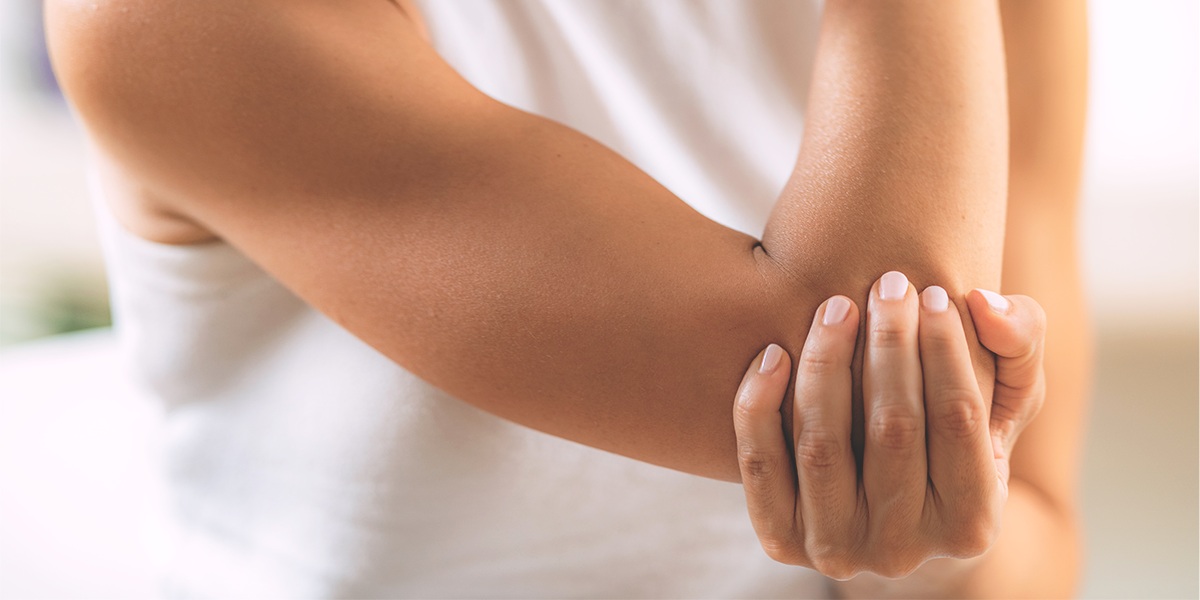
The main symptom of Tennis elbow is the pain felt on the outside of your elbow. This pain can range from mild to severe, from only feeling it when using your elbow to severe pain even when not moving your arm. This pain can sometimes radiate from your elbow to your forearm and wrist.
You will typically experience pain while:
- Gripping small objects
- Twisting your forearm
- Fully extending your arm
- Holding something in your hand, such as a cup
If you are experiencing the following symptoms, you may have Tennis elbow. Tennis elbow is not always a sports injury and can happen to anybody.
Common causes of Tennis Elbow
While Tennis elbow is typically known as a sports injury, it can happen to non-athletes as well. Tennis elbow occurs when the muscles in the forearm are strained and overused. The repetitive contraction of the forearm muscles that control the movements of your hand and wrist can cause tiny tears in the tendons that connect these muscles to the lateral epicondyle on the outside of your elbow.
As such, hand motions that require regular, repeated use of the forearm muscles can result in Tennis elbow. These motions can include:
- Plumbing
- Painting
- Using a screwdriver
- Cutting up cooking ingredients
- Regular and repetitive usage of a mouse at your computer
Risk Factors for Tennis Elbow
As the name suggests, Tennis elbow can be caused by playing tennis regularly due to the repetitive use of the forearm and elbow. However, similar sports and other activities that require the use of the forearm and elbow can also lead to the development of Tennis elbow. Risk factors for Tennis elbow may include:
- Regular participation in sports that require repetitive elbow and forearm motions
- Jobs that require repetitive elbow and forearm motions, such as a carpenter or a plumber.
- Physical trauma, such as a direct blow to your elbow.
- Age. The risk of developing Tennis elbow increases with age.
- Lack of stretching before engaging in sports.
Complications of Tennis Elbow
While Tennis elbow typically does not cause any severe health complications, it can result in chronic pain if left untreated. This chronic pain may get so severe that you find difficulty grasping items, potentially affecting your physical activity and work.
Diagnosing Tennis Elbow
To diagnose Tennis elbow, your doctor will conduct a physical examination, requiring you to carry out motions such as flexing your arm, wrist and elbow in order to see where you feel the pain. Imaging tests, such as an X-ray or MRI (Magnetic Resonance Imaging) maybe be suggested for further assessment in order to rule out other problems that may be causing your elbow pain.
Preventing Tennis Elbow
Preventive steps can be taken to avoid developing Tennis elbow. These include:
- Halting physical activity when you feel pain in your elbow. Pain is a signal from your body and ignoring this signal can lead to damage and tears to your tendons.
- Strengthen your forearms and wrist muscles so that they are better equipped to deal with strains and become less prone to injuries.
- Stretching your wrists and arms before carrying out physical activity can be effective in reducing the risk of injuries.
- An elbow brace should be used if your elbow is injured. This prevents the injury from worsening.
- Ensure that your sports equipment suits you. For example, a racquet that is too heavy for you may place additional stress on your arm.
Tennis Elbow Treatments
While Tennis elbow can go away on its own without treatment, it may last for up to 18 months, causing pain of varying degrees during this period of recovery. Treatment can help to speed up the healing process and at the same time, provide pain relief.
RestTo ensure a full recovery from Tennis elbow, sufficient rest is essential. The injured arm should not be used for straining activities. In addition, your doctor may suggest the use of a splint or brace to provide support for your elbow and prevent the tendons from being strained any further.
Physiotherapy for Tennis Elbow
Physiotherapy is one of the most effective non-surgical treatments for tennis elbow, helping relieve pain, restore tendon function, and prevent recurrence. Therapy focuses on improving the strength and flexibility of the forearm muscles, correcting faulty movement patterns, and reducing strain on the elbow. If tennis elbow results from sports technique, your physiotherapist may also provide guidance on stroke modification or equipment adjustments to reduce stress on the tendons.
A personalised physiotherapy program ensures that exercises and treatments are performed safely without aggravating the injured tendon. With consistent rehabilitation, physiotherapy helps promote blood circulation to the tendon, accelerate healing, and restore full function of the affected arm.
Physiotherapy for tennis elbow typically progresses through the following treatment focuses:
- Pain Relief, Tendon Load Reduction & Early Mobility Phase
- Manual therapy including soft tissue mobilisation, cross-friction massage, and myofascial release to reduce tension and improve tendon mobility
- Joint mobilisation to restore normal mechanics of the elbow and wrist joints
- TENS therapy to reduce pain levels during the early recovery phase
- Ultrasound therapy to promote tissue healing and reduce inflammation in the affected tendon
- Gentle range-of-motion exercises to reduce stiffness and maintain mobility in the elbow and wrist
- Strengthening, Flexibility & Tendon Conditioning Phase
- Eccentric strengthening exercises for wrist extensors to stimulate tendon repair and increase load tolerance
- Forearm strengthening exercises targeting wrist flexors/extensors, grip muscles, and forearm stabilisers
- Stretching exercises to improve flexibility in the wrist extensors and flexors, reducing tension on the affected tendon
- Soft tissue mobilisation to break down adhesions or scar tissue around the tendon
- Postural and ergonomic correction to reduce overuse strain on the forearm during daily activities or work
- Advanced Strength, Functional Training & Return-to-Activity Phase
- Progressive strengthening to build resilience in wrist, elbow, and shoulder musculature
- Functional exercises simulating sports strokes, work-related tasks, or gripping activities
- Technique retraining for sports such as tennis, badminton, or squash to prevent recurrence
- Home exercise programs to maintain tendon strength and flexibility between sessions
- Guidance on safe return to sports, occupational tasks, and recreational activities based on pain levels and strength progression
With a structured physiotherapy plan, most individuals experience significant pain reduction, improved tendon function, and a return to normal activities without recurring tennis elbow symptoms.
TCM for Tennis Elbow
Traditional Chinese Medicine (TCM) provides natural, holistic treatment options for tennis elbow by addressing both the pain and the underlying imbalance affecting the tendons and muscles. TCM aims to reduce inflammation, relieve pain, improve circulation, and support the body’s natural healing processes.
By combining acupuncture, herbal medicine, cupping, gua sha, and moxibustion, TCM helps restore balance to the affected meridians while promoting healthy tendon recovery. Treatment is personalised to each individual’s condition and overall constitution.
TCM treatment for tennis elbow generally includes the following therapeutic focuses:
- Pain Relief, Inflammation Reduction & Early Healing Phase
- Acupuncture to stimulate Qi flow, relieve pain, and reduce inflammation along meridians affecting the elbow
- Cupping therapy to improve blood flow, release muscle tension, and alleviate stiffness around the forearm and elbow
- Gua Sha to promote microcirculation, reduce inflammation, and ease tendon irritation
- Moxibustion to warm meridians, enhance circulation, and support tendon healing
- Restoring Tendon Health, Circulation & Muscle Balance
- TCM herbal medicine using formulas that contain herbs with anti-inflammatory, analgesic, and tendon-strengthening properties
- Local meridian-based treatments to regulate Qi and blood circulation around the lateral elbow
- Long-Term Balance, Strengthening Support & Recurrence Prevention
- Ongoing acupuncture sessions to maintain smooth Qi and blood flow through the affected meridians
- Herbal support to strengthen connective tissues and enhance musculoskeletal resilience
- Postural and movement guidance to reduce stress on forearm tendons during daily activities or sports
- Home-based warming therapies such as moxa heat packs to promote circulation and prevent stiffness
- Recommendations for lifestyle adjustments to prevent re-aggravation of the elbow
With consistent TCM treatment, individuals often experience improved circulation, reduced pain, enhanced tendon strength, and better long-term resilience against recurrent tennis elbow symptoms.
Manage and relieve tennis elbow with Regis Wellness
Get regular updates from Regis Wellness!
Subscribe to our email newsletter and stay updated with the latest health topics and tips to manage your health and wellness.
Disclaimer:
The information on this website, including but not limited to, text, graphics, images, videos and all other materials contained on this website is for informational purposes only. None of the material is meant to replace a certified and registered Doctor's professional medical advice, diagnosis, and treatment.
No warranties or representations are given in respect of the medical information. Regis Wellness, Regis Wellness’s staff, and the website's operator will not be held liable if a user suffers any injury or loss after relying upon the medical information on this website.
Any devices used for technology-enhanced therapies are intended for use only for general well-being purposes or to encourage or maintain a healthy lifestyle and is not intended to be used for any medical purpose (such as the detection. diagnosis, monitoring, management or treatment of any medical condition or disease). Any health-related information provided by this device or software should not be treated as medical advice. Please consult a certified and registered Doctor for any medical advice required. As with all medical conditions, there are exceptions and nuances to individuals’ condition and treatment modalities. We aim to provide only a general understanding for each section.
A. Molsberger, E. Hille, “THE ANALGESIC EFFECT OF ACUPUNCTURE IN CHRONIC TENNIS ELBOW PAIN”, Rheumatology, Volume 33, Issue 12, December 1994, https://doi.org/10.1093/rheumatology/33.12.1162
DerSarkissian, Carol. “Tennis Elbow (Lateral Epicondylitis).” Tennis Elbow Symptoms, Causes, and Treatments, WebMD, 13 June 2020, https://www.webmd.com/fitness-exercise/tennis-elbow-lateral-epicondylitis
Felson, Sabrina. “Sore Arm? It Might Be Tennis Elbow.” Tennis Elbow: Causes, Symptoms, and Risk Factors, WebMD, 5 Feb. 2022, https://www.webmd.com/pain-management/tennis-elbow.
K., Kristina & Zhu, at el. “Tennis elbow treatment with acupuncture”. 2017.
“Overview.” Tennis Elbow - NHS, NHS, 10 Nov. 2020, https://www.nhs.uk/conditions/tennis-elbow/.
“Shoulder and Elbow - Tennis Elbow/Lateral Epicondylitis.” Tennis Elbow/Lateral Epicondylitis: Overview, Causes, Symptoms, Risk Factors, SingHealth, https://www.singhealth.com.sg/patient-care/conditions-treatments/shoulder-elbow-tennis-elbow-lateral-epicondylitis.
“Symptoms.” Tennis Elbow - Symptoms, NHS, 10 Nov. 2020, https://www.nhs.uk/conditions/tennis-elbow/symptoms/
“Tennis Elbow (Lateral Epicondylitis).” Tennis Elbow: What It Is, Causes, Symptoms & Treatment, Cleveland Clinic, 17 June 2021, https://my.clevelandclinic.org/health/diseases/7049-tennis-elbow-lateral-epicondylitis#:~:text=What%20are%20the%20complications%20of,serious%2C%20long%2Dterm%20problems
“Tennis Elbow.” Tennis Elbow - Causes, Symptoms, Treatment, Diagnosis, MedBroadcast, https://medbroadcast.com/condition/getcondition/tennis-elbow.
“Tennis Elbow.” Tennis Elbow - Diagnosis and Treatment, Mayo Foundation for Medical Education and Research, 25 Feb. 2021, https://www.mayoclinic.org/diseases-conditions/tennis-elbow/diagnosis-treatment/drc-20351991
“Tennis Elbow.” Tennis Elbow - Symptoms and Causes, Mayo Foundation for Medical Education and Research, 25 Feb. 2021, https://www.mayoclinic.org/diseases-conditions/tennis-elbow/symptoms-causes/syc-20351987.
“Treatment.” Tennis Elbow - Treatment, NHS, 10 Nov. 2020, https://www.nhs.uk/conditions/tennis-elbow/treatment/#:~:text=Tennis%20elbow%20will%20get%20better,activity%20that%20caused%20the%20problem
Verma, Nikhil. Tennis Elbow Causes and Risk Factors, Sports-Health, 30 Jan. 2015, https://www.sports-health.com/sports-injuries/elbow-injuries/tennis-elbow-causes-and-risk-factors.
Verma, Nikhil. Tennis Elbow Treatment, Sports-Health, 30 Jan. 2015, https://www.sports-health.com/sports-injuries/elbow-injuries/tennis-elbow-treatment.
Wheeler, Tyler. “Do I Need Physical Therapy for Tennis Elbow?” Physical Therapy for Tennis Elbow: Exercises, Pain Relief, and Recovery, WebMD, 26 Apr. 2021, https://www.webmd.com/pain-management/physical-therapy-for-tennis-elbow